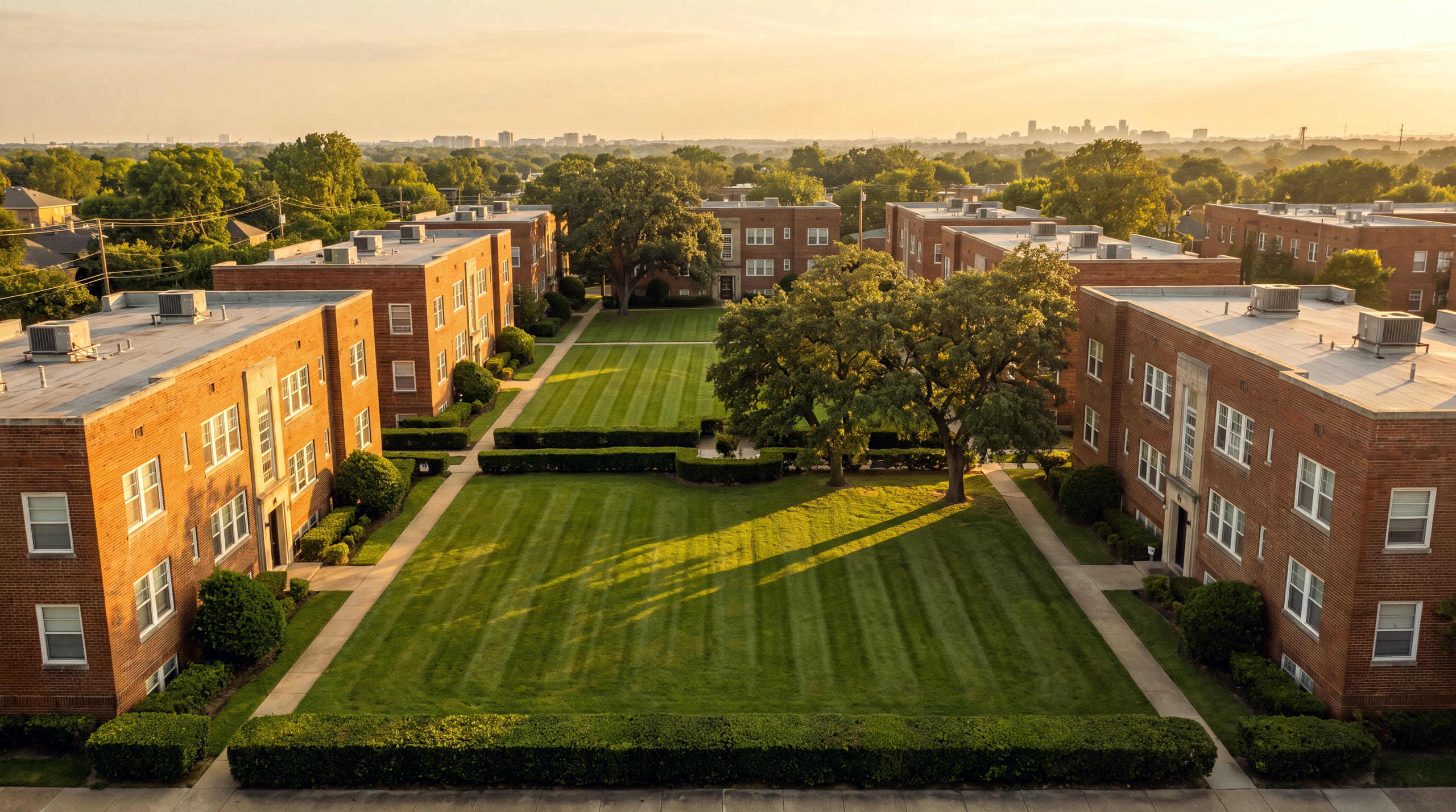
A founder’s account — told by Mark Pjeternikaj, who ran the turnaround.
Initial Operating Conditions
In 2007, my family acquired a 206-unit operationally challenging urban community in Elizabeth, New Jersey — with declining standards, inconsistent screening and lease enforcement, excess staffing, high utility costs, deferred maintenance issues, and a damaged market reputation.
Problems ran through nearly every corner of the operation, and the property had earned a reputation for weak management — the kind of reputation that shows up in vacancy, collections, and turnover long before it shows up anywhere else.
Where the Prior Owner Went Wrong
The prior owner recognized the problem and tried to solve it by spending money. Through 2005 and 2006, significant capital went into apartment renovations — kitchens, bathrooms, interiors. The properties kept struggling anyway.
The problem was never a lack of investment. The assumption was that better apartments would produce better performance. They didn’t. No matter how attractive the renovated units looked, the property’s reputation and operating condition outweighed anything happening inside the units. Eventually, ownership sold.
A property that cannot execute does not become
a better property with better finishes.
The market was not looking for granite countertops. It was looking for a safe, well-managed community with convenient access to work. Until that was solved, no amount of renovation was going to change the trajectory. People do not simply rent an apartment — they rent a location, a community, a reputation, convenience, and a quality of life.
Problems Identified
What I Saw in Due Diligence
The signs of poor management were in plain sight:
- Unrepaired leaks and overcrowded apartments
- Weak tenant screening, with lease provisions rarely enforced
- Excess staffing carrying no accountability
- Expensive contractors delivering poor workmanship
- Neglected landscaping
Collectively, these were costing ownership substantial money while degrading the resident experience. The prior owner focused on renovating apartments. I focused on managing real estate.
Actions Taken
Capital Where It Counts
Rather than continue the prior owner’s renovation program, capital went only where it changed the numbers:
- Photocells replaced basic timers, so lighting ran only when needed
- Aging boilers and hot water heaters replaced with efficient systems, ending expensive repairs
- Boiler controls installed to prevent overheating
- Attics and crawlspaces insulated
- Proactive apartment inspections for leaks and overcrowding, cutting water and sewer expense
- Landscaping, roofing, painting, and other contracts competitively rebid
People, Process, and Product
People
The payroll was large. The performance was not.
I rebuilt the team from the ground up, sizing it to what the property genuinely required rather than what it had inherited. Every position came with defined duties, so there was never ambiguity about who was responsible for what. When someone fell short, it was addressed immediately — at a property like this, tolerated underperformance compounds by the week.
The outcome was a staff roughly half the cost of the old one that accomplished more, because accountability was built into the structure rather than hoped for.
Process
The operation ran on communication. Delays, new developments, which apartments had to be ready by their rented dates — the team was kept current on all of it, constantly, so nothing sat waiting for direction.
Screening standards were applied consistently, lease provisions were enforced, overcrowding and other lease violations were addressed, and property standards were restored. Over time, these changes improved community stability, resident experience, and the property’s reputation.
Product
Throughout the repositioning, I set the product and the pricing myself.
What this market needed wasn’t finishes — the prior owner had already proven that. It needed a community that functioned: apartments ready on schedule, problems resolved, a reputation earned back one interaction at a time.
It also needed a customer. The property sat minutes from Newark Liberty International Airport, and airport employees became ours. These were never meant to be luxury apartments. What they offered was convenience, affordability, safety, and proximity to work — and the product matched the customer precisely.
Targeted outreach to employees of the airport and the airlines operating there, together with an active resident-referral program, expanded the qualified applicant pool. As property operations and service improved, referrals increased and the community’s reputation strengthened.
Financial Result
Heating costs fell roughly in half. Water and sewer fell by a third. None of it was cosmetic, and all of it showed up on the operating statement — during years when the broader market was collapsing.
As the property delivered consistently, rents climbed approximately 30% — through the depths of the financial crisis, in a submarket most operators would have written off.
After Stabilization
With the property stabilized, day-to-day operations passed to a traditional property manager under my continued oversight and support. The turnaround work was done; the standards it established remained.
That handoff reflects a fundamental distinction. Repositioning is hands-on turnaround work — setting product and pricing strategy, driving the lease-up, managing delays, pushing occupancy toward stabilization. Traditional property management is steady-state operations: maintaining a stabilized asset and preserving the value that was created. I drive the repositioning, then step back into a supervisory role while the day-to-day is handed off.
The Lesson
Capital alone cannot fix an operating problem. The Elizabeth turnaround succeeded because stronger management determined where operational changes and targeted investment could produce a measurable return.
Put the right people in the right structure, keep them accountable and informed, and deliver what the market is actually asking for — and even a property everyone else has given up on can produce returns through the worst economy in a generation.
The buildings did not fundamentally change.
The management did.